Dr Tom Shurlock, Consultant Nutritionist for British Horse Feeds explains how exercise can affect the stomach and why feeding Fibre-Beet as a pre-exercise meal can help keep the gut healthy.
It is generally accepted that a major contribution to gastric ulcers is exercising on an empty stomach. The muscular action forces stomach acid beyond the protective layer of the stomach, where it can burn the squamous region.
How exercise affects the stomach…
Both the intensity and frequency of exercise have a bearing on the increase in ulceration, although mainly as grade 1 ulcers; subsequent management practices can exacerbate this leading to higher grades.
Exercise increases blood flow to the muscles being used, routing blood flow away from the stomach and gut. This can hamper gastric mucus production leaving the stomach vulnerable to acid and can cause low level Equine Glandular Gastric Disease (EGGD).
At the same time exercise increases stress. The result of this increases levels of cortisol in the saliva and the release of the ACTH hormone – both factors implying that stress contributes to EGGD by weakening the gastric membrane.
Equine Squamous Gastric Disease is also increased by the frequency and intensity of the exercise. Exercise brings an increase in intra-abdominal pressure that alters the gastric pH gradient, resulting in a more acidic gastric environment.
There is also the aspect of feeding frequency. Data shows that there is a circadian rhythm of gastric acid release, with the lowest pH being achieved between 1:00 and 9:00 in the morning.
Strategies to avoid ulcers
There are a number of strategies to help avert the development of ulcers, based on the properties of various feeds.
Fibre is possibly the most obvious component; constant grazing, continuous saliva supply and a full stomach all help to maintain the correct level of acidity in the stomach, and so help prevent free acid based ulceration. However, there are other properties that help with acidity, stomach burning and ulceration, and have a special relevance in pre-exercise feeding.
Firstly, pectin: A form of soluble fibre that, in the presence of emulsifiers (oat fibre), can bind and extend the mucus lining of the stomach extending the physical protection within the stomach.
Secondly alfalfa and beet pulp both have a high acid binding capacity; basically this sucks in and traps free acid, raising the pH of the stomach contents.
Thirdly Fibre-Beet is fed as a wet feed; this encourages chewing and increased saliva into the matrix giving a greater buffering power.
Fourthly, Fibre-Beet is designed to be fed as discreet meals. Reports have shown that feeding high energy fibre feeds as three meals a day has a continuing effect in aiding gastric health.
Putting together all these components it would be expected that Fibre-Beet may have a significant effect in maintaining reasonable acidity levels in the stomach.
The Research…
Modelling work, conducted at Glasgow University illustrated this effect. By mimicking the conditions in the saliva, the squamous region and the gastric region, Fibre-Beet kept the pH of the stomach above 4, the optimum level for equine digestion.
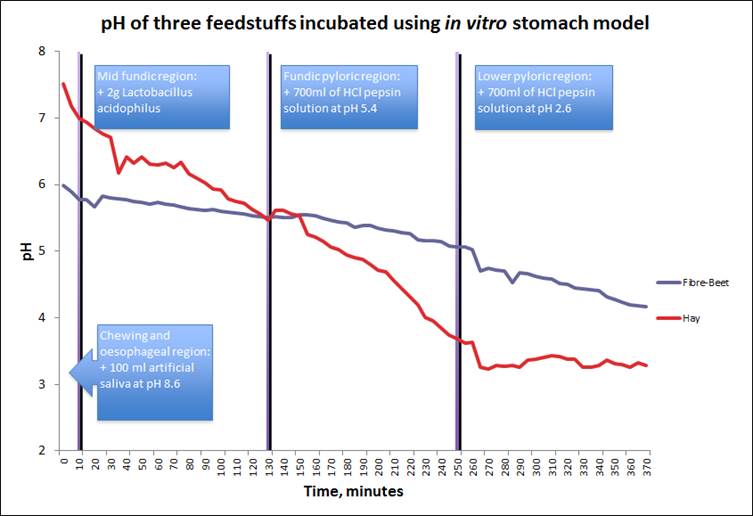
This data shows that there is a six-hour time lag across the stomach. This ties in with observations that feeding alfalfa-based products can give gastric “protection” for up to six hours. Not all of this is due to the product remaining in the stomach but shows a time effect of maintaining pH.
Fibre-Beet works at two levels. Fed before exercise it supports a good pH by buffering and absorbing free acid, as well as extending the mucus protection into the squamous region. This gives a high base line from which pH is decreased and EGGD is promoted during subsequent exercise. In effect it gives a pre-treatment to an empty stomach.
However, it is not necessary to withdraw feed before exercise. Feeding Fibre-Beet up to the start of exercise will ensure there is some material remaining in the stomach during exercise.
Data shows that horses are not compromised by feeding a fibre-based diet up to exercise but using Fibre-Beet gives the horse’s stomach a head start for gastric health.
Find out more about Fibre-Beet here.